
Yes, AI Max is Amazing, But Don’t Treat it Like a Checkbox.: A Q&A with Emily Dominguez
By Calvin Scharffs
AI-powered advertising tools are moving into the mainstream, and if you listen to recent press coverage, they’re positioned as a way to “recession-proof” a business. Platforms like Google and Meta are making it easier than ever to turn on automation and let performance “scale.”
At Orange 142, we’re enthusiastic about these tools and actively test and use them. But we don’t buy into the “set it and forget it” promise of AI ad tech. Google’s latest release, AI Max, is powerful, but it also comes with risk.
To understand how AI Max for Search actually performs in the real world, I spoke with Emily Dominguez, Orange 142’s Pay-Per-Click Manager, who has been leading hands-on testing across industries and campaign types. What did I learn? AI Max is definitely powerful and can deliver amazing results, as long as the proper guardrails are in place.
CS: Last time we spoke, AI Max was in its infancy. Let’s start simple. What is AI Max?
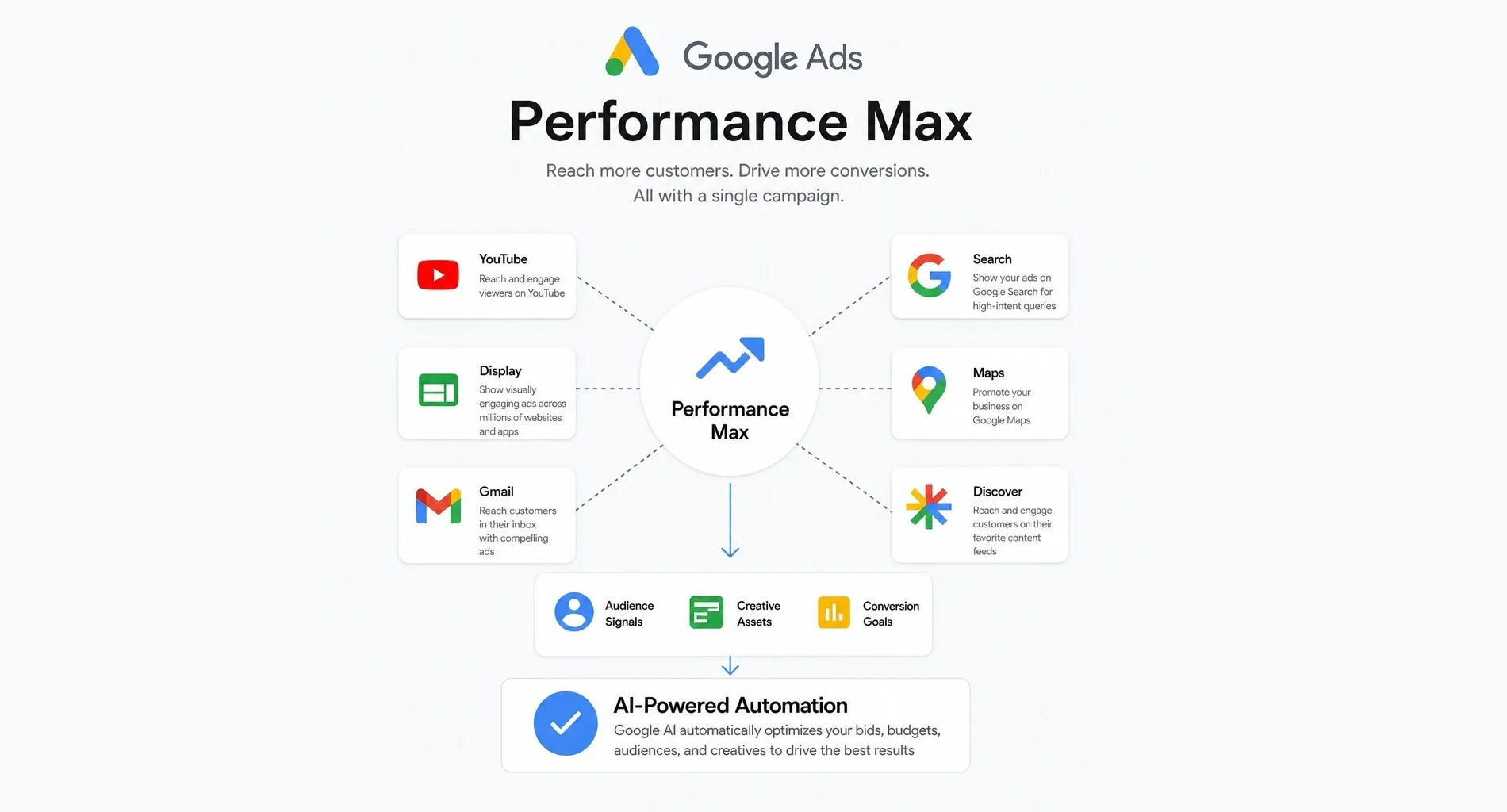
ED: Yes, I remember that conversation; everything we said about PMax and Demand Gen still applies. AI Max is really the missing piece.
The easiest way to think about it is that it brings AI-driven optimization into search campaigns, which were previously left out of most automation tools.
PMax and Demand Gen are built around audiences and creative assets. AI Max is built for the search results page, where intent still matters most. It expands beyond your keyword list to match additional relevant searches, uses audience signals to refine targeting, and can optimize text-based assets. It’s essentially Google’s AI layer for the keyword-driven side of PPC.
CS: So this is Google’s answer to AI on the search side?
ED: Exactly. Search has always been about what the user types in. AI Max keeps that foundation but adds more intelligence on top of it. It’s not just matching keywords anymore; it’s interpreting intent using signals beyond search history and applying that to how your ads show up.
CS: There’s a narrative right now that tools like this are easy wins. Can anyone just turn it on and see results?
ED: Technically, yes. Google has it so that it’s literally a checkbox. But strategically? The answer is no.
If your underlying search campaigns aren’t structured properly, AI Max won’t fix them. It’s going to amplify whatever’s already there. In some cases, that can actually hurt performance by pulling in irrelevant queries or expanding into areas you don’t want to pay for.
The bottom line is you need a bulletproof search foundation before you even think about turning it on.
CS: Got it. But what exactly does “bulletproof” mean in this context?
ED: Good question. It starts with a clear campaign structure and clean data. You need strong separation between brand and non-brand terms, clear mapping between keywords and intent, and match types that are intentional and controlled.
You also need to be able to track performance at a granular level. If you can’t track it, you won’t know what AI Max is actually doing or whether it’s working.
CS: What are match types?
ED: Think of match types as instructions you give Google so it knows how closely to match your keywords to a user’s search. You’re essentially defining how strict or flexible that matching should be before your ad shows.
At one end is very tight control, where you tell the platform, “only show my brand for queries that are very close to this exact term.” At the other end, you give Google more freedom to interpret what the user might mean and match you to related searches.
Match types themselves are pretty straightforward. The real impact comes from how you structure them. If they’re not aligned to intent, you lose control of your data. But if they’re set up cleanly, they give you a very clear signal of what’s working and who is engaging from an audience perspective, and that’s what tools like AI Max rely on.
This is critical because once you start layering in something like AI Max, it’s going to use your keyword setup as a signal. If your match types are loose or all lumped into just one match type, you’re basically giving it unclear instructions. If they’re clean and controlled, it has a much better idea of what “relevant” actually means for your business.
CS: Google recommends turning on features such as asset optimization and URL expansion. What are those features, and should advertisers turn them on with each campaign?
ED: Asset optimization tells Google that it’s okay for its AI to rewrite your ad copy. URL expansion lets it change your landing page. Both can improve performance in theory, but they also introduce risk, which is why we never advise turning them on blindly.
If your campaign isn’t tightly controlled, you may show users messaging that isn’t brand-approved or send them to the wrong experience. You may also optimize towards the wrong signals, which won’t support your business goals but will quickly spend down your budget.
We never turn on those features without strict oversight for these very reasons.
CS: So there are brand safety and budget risks?
ED: Yes, there are both. On the budget side, AI Max can expand into irrelevant or low-quality searches, which means you’re paying for traffic that doesn’t convert.
There’s also placement risk. If your broader campaign settings allow it, AI Max may shift your spend to cheaper inventory, such as the Google Display Network, to meet efficiency targets. But that may not be where you want your ads showing.
Brand marketers want control over the environments where their ads appear, and this can take some of that control away if it’s not managed carefully.
CS: Let’s talk about where AI Max actually works. Who should be using it?
ED: The best use cases have a few things in common. The first is that you’re optimizing toward a hard conversion, so something like ticket sales or qualified leads, not softer engagement-based conversions, like a page view.
You also need a clear understanding of your ideal audience. You have to know what “good” looks like, because that’s what the system is going to learn from.
Then, from a funnel perspective, AI Max works best when the desired outcome is high-return and combined with search intent and high-funnel, prospecting audiences.
CS: You tested this with Edelman Fossil Park. What did you learn?
ED: The biggest takeaway from the Edelman Fossil Park case study was that AI Max does not like to stay niche. We initially tried to constrain it to very specific use cases, such as niche event searches, but it didn’t perform well in that environment.
But when we gave it access to a broader non-brand search strategy, while keeping our intent signals tightly controlled, it performed extremely well. It started driving non-branded ticket sales, which was a strong indicator that it was finding net-new demand.
CS: That’s amazing, and it sounds like real prospecting, not just optimization.
ED: Exactly. It was acting like a lower-funnel conversion tool, even in a prospecting context. That’s what made it so powerful, and why it’s getting so much press. But again, AI Max was successful precisely because the underlying campaign was carefully structured to guide it and had a long history of gathering signal data.
CS: So the opportunity is unlocking new demand, but with a catch.
ED: Yes, and the catch is that you can give it freedom, but with boundaries.
If you restrict it too much, it won’t scale. If you give it too much freedom without controls, it will waste your budget. Success comes from a strong foundational setup, clear conversion signals, and controlled expansion. That balance is everything.
CS: You mentioned earlier that AI Max is also important for visibility on the search results page itself. Can you explain that?
ED: Yes, this is big. More and more, Google is using AI to shape the search results page, including AI Overviews. Previously, tools like Performance Max (PMax) helped advertisers reach those environments, but after recent updates, AI Max is now the primary way to secure visibility there.
So this isn’t just about backend optimization; it’s also about future-proofing your presence on the SERP.
CS: Final question. Should advertisers experiment with AI Max right now?
ED: Yes, but not casually. This is a powerful tool that can absolutely drive incremental performance and uncover new demand. But it requires preparation, testing, and ongoing oversight. What Google recommends as “best practice” isn’t always what’s best for your business. That’s why agency expertise is so important.
About Calvin Scharffs
Calvin Scharffs is a global marketing executive with over 20 years of experience in programmatic advertising, AdTech, and SaaS. He has led brand, product marketing, and demand generation teams across North America, APAC, and EMEA, helping companies sharpen their positioning and accelerate growth. A founding member of his company’s AI Council, Calvin is passionate about the responsible adoption of AI in marketing and go-to-market strategy. He is a regular contributor to industry conversations through earned media, speaking engagements, and thought leadership publications.