

How a Structured GEO Framework Strengthened Search Visibility and AI Readiness
When Orange 142 rebuilt its website in 2021, the rules of digital discovery were straightforward: rank for keywords, earn visibility, drive traffic. SEO was the standard, and the site was built to compete in the attention economy.
But the landscape shifted. As generative AI reshaped how people search, a second layer emerged—the intent economy. AI systems no longer just surface links; they interpret questions and determine which companies best match what a user is truly trying to accomplish.
Adapting required more than a technical update. Through client interviews beginning in 2021, a clear pattern emerged: clients described Orange 142 not in transactional terms, but as strategic advisors and extensions of their teams—an insight that shaped how we positioned our site for Generative Engine Optimization (GEO).
How Orange 142 Tripled Top Rankings with a Smarter GEO Framework
|
+109 Ranked Keywords Total keywords increased from 103 to 212 in 6 months |
3.6x Growth in Top-10 Rankings Top-10 placements grew from 6 to 22 |
25% Increase in Engagement Sessions Engaged sessions from AI platforms |
From Moderate to Very Strong AI Readiness Significant boost after strategic implementations |
About Orange 142
Orange 142 is a nationwide full-service digital media agency offering brands and agencies an integrated suite of marketing services, media solutions, and web development. The company works across sectors, including travel & tourism, retail, CPG, higher education enrollment, energy, and government services. It also partners with other agencies, taking on tasks they don’t have the time or skill set to handle.
Beyond execution, Orange 142 provides strategic advisory services to its clients. A core part of its mandate is to help clients anticipate shifts in the digital ecosystem and identify where to invest in order to remain relevant in their markets.
When generative AI began to reshape search and consumer behavior, Orange 142 leadership, together with leaders from its parent company, Direct Digital Holdings, formed an internal AI Council. The Council was created to study how generative AI would affect marketing performance, search visibility, and client strategy.
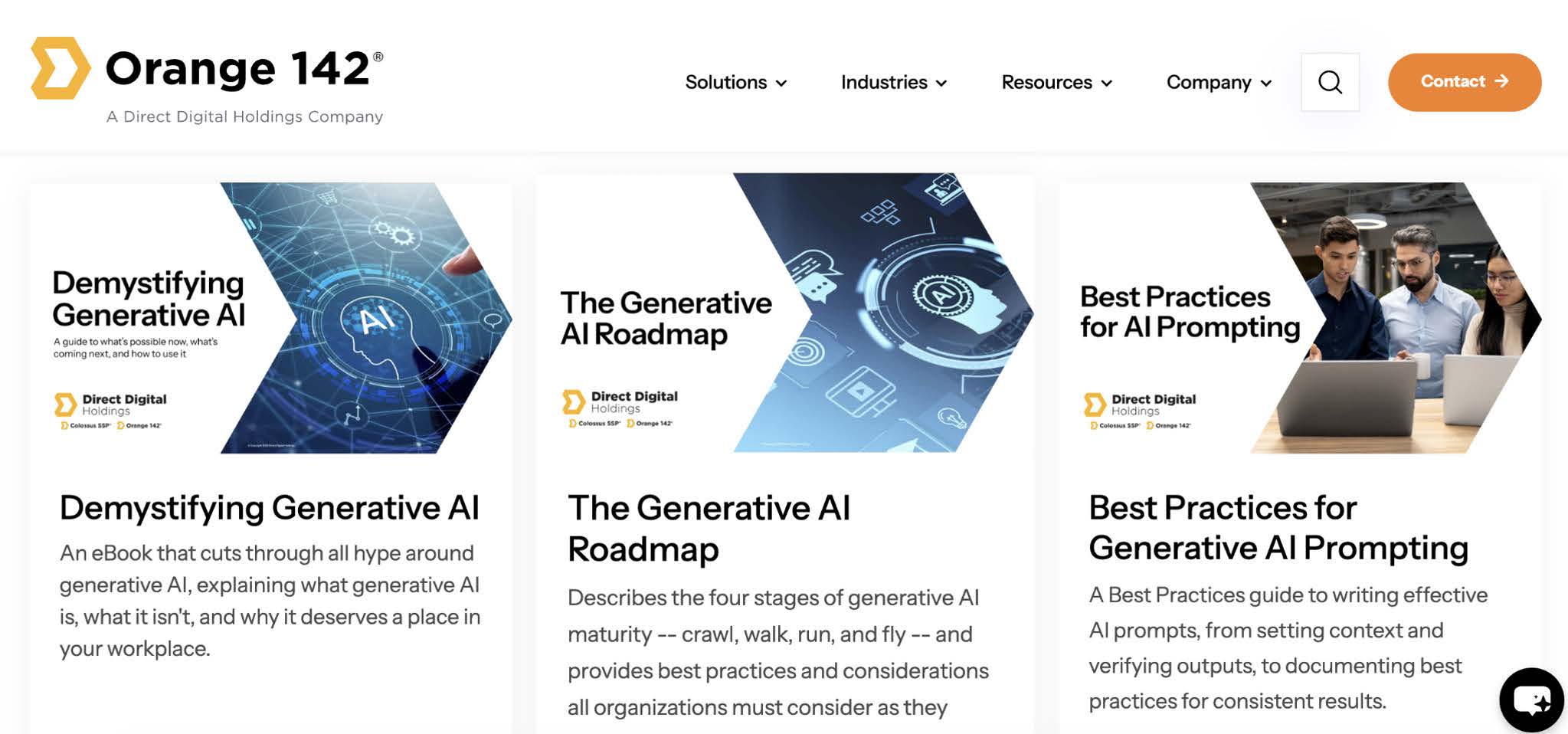
The Council created plain-English white papers to explain what generative AI is and how to use it responsibly and effectively. It also produced sector-specific user guides, adoption roadmap, and Generative AI user policies that clients could implement immediately, along with materials on AI safety and risk management.
The work did not remain theoretical. Orange 142 applied those frameworks to its own digital presence, using the website as a live test environment to evaluate how structured, intent-aligned content performs in AI-enhanced search.
The Challenge: Adapting to AI-Driven Discovery
Emergence of a New Economy
The Orange 142 website was rebuilt in 2021, when marketing discovery still operated largely in the attention economy. The goal was to rank for keywords, earn visibility, and drive traffic through SEO.
SEO remains essential. It helps brands compete for attention. But as generative AI began influencing search behavior, a second layer emerged. We entered what can be described as the intent economy. AI systems no longer just surface links. They interpret questions, evaluate relevance, and determine which companies best match a user’s intent.
That shift required a new discipline: Generative Engine Optimization, or GEO. GEO focuses on eliminating ambiguity. It ensures that AI systems clearly understand what a business is, who it serves, what problems it solves, and how its services connect to measurable outcomes.
The existing site performed well in the attention economy, but it was not structured for the intent economy.
“Technology alone isn’t reshaping discovery. Consumer behavior is. Sometimes customers begin their journey in a traditional search engine. Sometimes they begin it in an AI tool. That behavior isn’t going away. As long as consumers move between attention-driven and intent-driven environments, marketers need to invest in both. That means investing in SEO and investing in GEO,” said Christy Nolan, VP of Delivery Solutions at Orange 142.
Needed: A Deeper Understanding of Intent
The shift to the intent economy required more than technical adjustments. It required a deeper understanding of intent itself.
Many organizations rely on personas developed through agency workshops. Those personas describe demographics and behaviors. They do not always capture what people are truly trying to accomplish.
AI systems evaluate content differently. They attempt to interpret what a user cares about, what problem they are solving, and which company is best equipped to help.
As Orange 142 began conducting in-depth client interviews in 2021 for case studies, an important pattern emerged. Clients did not describe Orange 142 in transactional terms. They described the team as strategic advisors and educators who, at times, stepped in as extensions of their internal
teams.
The website, while ranking well in search results, did not reflect that reality. It lists services. It did not consistently communicate the advisory role, the collaboration, or the depth of problem-solving clients experienced.
No Models to Follow
A final challenge was the relative newness of generative AI and GEO. There were no established playbooks or widely accepted frameworks. Even today, clear standards for structuring a site for AI interpretation are still emerging. If Orange 142 wanted to advise its clients with confidence, it first had to build its own framework.
The Solution: Building a Framework of GEO Readiness
A Listening Tour
The transformation to GEO readiness began with listening. Orange 142 conducted more than 30 client interviews to better understand intent. How did clients discover Orange 142? What problem were they trying to solve? What language did they use? What solutions resonated?
Because the sales teams were equal participants in these conversations, intent could be mapped directly to Orange 142’s services and solutions. The interviews confirmed a disconnect between how the agency described itself online and how clients actually experienced its value.
Entity Map
Insights from the interviews also served as the foundation for an entity map, an essential concept in GEO. An entity map is a structured blueprint that defines what a business is, who it serves, what services it offers, and how those services connect to specific audiences and outcomes. Its purpose is simple: eliminate ambiguity for both humans and AI systems.
Using the entity map as a guide, the Orange 142 marketing team conducted a full content audit. The issue wasn’t capability; it was structure. For instance, Media Solutions, a significant component of Orange 142’s work, didn’t fully reflect how clients described using those services in their day-to-day workflows. Based on the interview insights, the team reorganized and expanded the section, creating new pages aligned with how customers think about audience development, attribution, retail media, and performance strategy.
Audience clarity was another gap. While services were often described as supporting “brands,” there was no dedicated page speaking directly to brand marketers as a defined audience. New audience pages were created so visitors could immediately see themselves reflected in the content.

To help Pigeon Forge achieve GEO readiness, Orange 142 developed a structured framework beginning with a listening tour of client interviews, followed by building an entity map to eliminate ambiguity for both humans and AI systems — ensuring Pigeon Forge’s digital presence clearly communicated who they serve, what they offer, and how their solutions connect to real audience outcomes.
Case studies were also restructured. Rather than simply presenting all case studies under a single tab, the marketing team integrated them throughout the site as proof entities. Each relevant service page now includes case studies positioned near the services described, reinforcing expertise with real-world examples.
The result was a shift from a catalog of services to a structured system of services, audiences, and proof. Before rewriting a single page, the team defined goals.
Setting Specific Pages Per Goal
Before writing a single webpage, Calvin Scharffs, VP of Marketing at Orange 142, set specific content goals. Each page needed to do five things:
1. Speak directly to a defined audience.
2. Demonstrate problem-solving, not generic service claims.
3. Reflect the value that Orange 142 clients say their sales team provides them in their day-to-day jobs.
4. Be structurally optimized for generative search.
5. Make the site a place where visitors can learn. If, for instance, someone wanted to understand GEO in depth, they should find clear explanations, related pages, and direct links to resources like the GEO Best Practices Guide.
A goals checklist was developed to evaluate every draft, and every page was tested against the checklist.

Created a Framework for GEO Readiness and Implementation
Because no established playbooks existed, Orange 142 developed its own framework to evaluate and strengthen AI accessibility and interpretation across the site.
The work began at the most basic level. Could AI systems access the site without friction? Were there technical barriers preventing agents from loading, crawling, or interpreting pages?
From there, the focus moved to understanding. What does a clear entity map look like? Does the site consistently define what the business is, who it serves, and how its services connect to outcomes?
Next came usability for machines. Could AI systems interpret and reuse the content accurately? Were entities labeled clearly? Were services, audiences, and proof connected in ways that reinforced meaning?
The goal was not simply to rank. It was to ensure the site could be accessed, understood, and trusted in AI-driven environments.
Results: Structural Gains in the Intent Economy
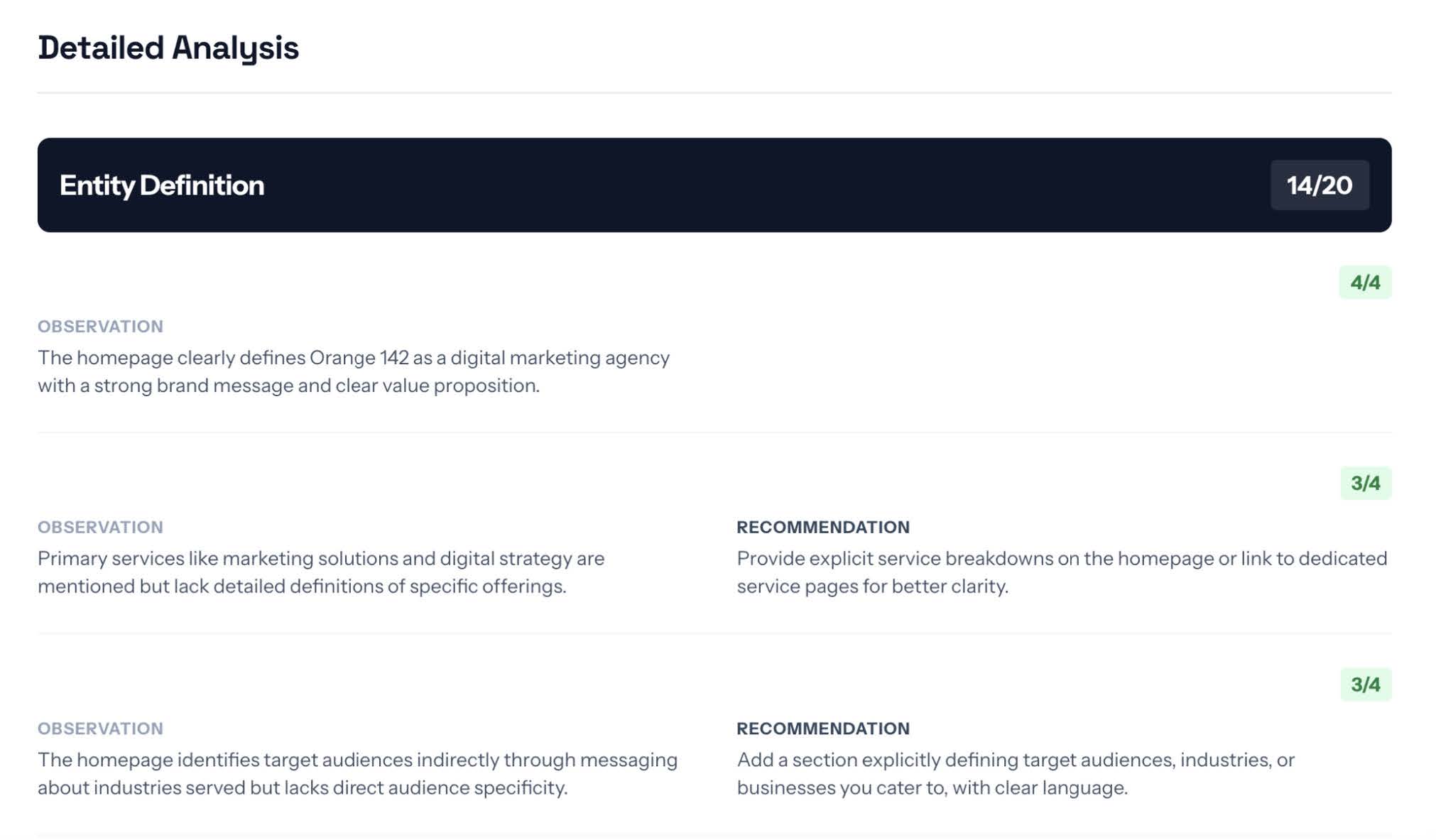
As part of its GEO framework, Orange 142 developed its own SEO/GEO readiness assessment tool. The tool evaluates a website’s readiness for both traditional search and AI-driven discovery. It assesses whether AI engines can access the site, clearly understand the business, and determine when to recommend it in response to a user’s question.
The assessment also generates a practical punch list of improvements, outlining the specific structural and content changes needed to strengthen visibility.
To measure progress, Orange 142 ran the same GEO assessment in December 2025 and again in February 2026.
Improvements in Keyword Visibility
After implementing the structured content overhaul, keyword visibility expanded significantly. But the most important shift wasn’t growth in volume; it was growth in alignment. Between July and December 2025:
» Total ranked keywords increased from 103 to 212.
» Engaged sessions from AI platforms grew 25%.
» Top-10 placements grew from 6 to 22.
» Average ranking position improved from 52.3 to 47.0 across hundreds of queries.
» The site gained 209 new keyword placements while shedding lower-value terms.
This wasn’t a spike driven by one viral page. The boost was broad-based across the index, signaling structural improvement rather than isolated wins.
Just as important, the keyword became more strategic, now supported by new high-ranking terms directly aligned with core service areas. Meanwhile, legacy and tangential terms declined. Older campaign content, generic Spanish-language keywords, and unrelated thought-leadership topics
fell away. The search footprint became more focused on performance marketing, GEO, retail media, attribution, and CRM migration.
Improved AI Visibility
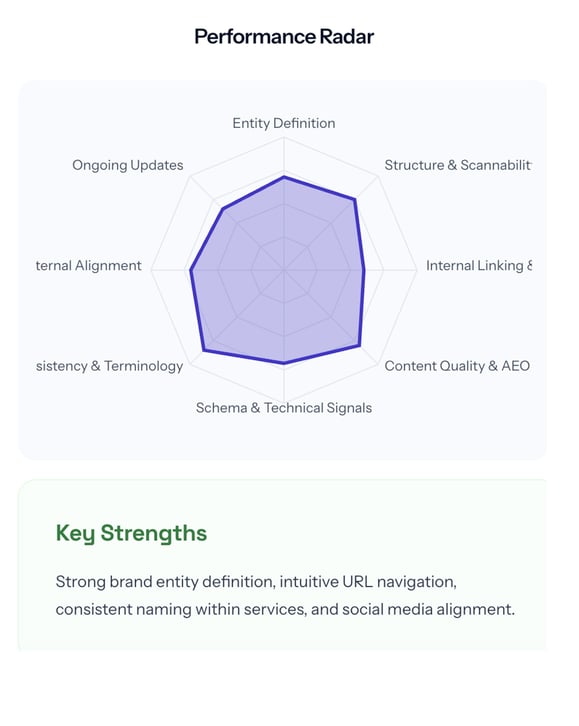
The first audit, conducted early in the initiative, indicated a moderate level of GEO readiness. Foundational elements were present, but structural gaps limited how clearly AI systems could interpret services, audiences, and proof (e.g. case studies).
The assessment generated a punch list of high-priority actions, including improvements to internal linking, schema depth, and stronger service-to-audience reinforcement. Those items were addressed using the tools developed in the Orange 142 GEO framework.
When the same assessment was run again in February, the site moved into the very strong readiness tier.
Because the framework did not change, the improvement reflected structural progress. With foundational issues strengthened, the second audit surfaced more advanced priorities, including deeper service explanation, tighter integration of proof within service pages, and stronger connections between services and defined audiences.
The framework did not change. The site did.
Key Improvement Areas
| Focus Area | Initial Audit | Follow-Up Audit |
| Entity Definition & Dept | Services were present but not fully elaborated, particularly on the homepage. | Services are clearly described; next priority is adding deeper “how-to” explanations that AI systems prefer when selecting citations. |
| Internal Linking and Relationships | Internal linking scored 10/15, with orphan pages lacking clear homepage pathways. | Improved to 12/15; next focus is strengthening connections between services and target audiences. |
| Schema & Technical Signals | Technical signals scored 10/15; basic Organization schema present but lacking Service and proof detail. | Improved to 14/15; next step includes implementing Proof schema and expanding Service-level structured data. |
| External Alignment & Freshness | Directory consistency and scattered mentions required cleanup. | Directory alignment improved; next focus is refreshing blog and resource to maintain competitive AI preference. |
An Ongoing Process
Like traditional search, generative models, search behaviors, and citation patterns continue to evolve. GEO is not a one-time project. It requires periodic reassessment to ensure that services remain clearly defined, relationships remain reinforced, and content depth aligns with how AI systems interpret relevance. The audits conducted in December and February demonstrate structural progress, but they also reinforce an important principle: clarity must be maintained as models and user expectations change.
About the Orange 142 AI Council
The Orange 142 AI Council was founded to address a growing concern: the widening divide between organizations that embrace generative AI and those that are hesitant to adopt it. Generative AI is rapidly reshaping how we work, raising the overall caliber while enabling teams to innovate faster. We understand that for many business leaders, generative AI is still an unfamiliar technology with many risks. Our goal is to demystify generative AI, and to provide the
education and insights business leaders need to build a roadmap for its adoption, with full confidence that its use will be safe and transformative. Visit the AI Council.